LED Lighting Installation: A Complete Guide for Commercial Buildings
LED lighting installation can help a commercial building use less electricity while improving how its spaces are lit. A successful upgrade starts with the work people do in each area, the condition of the existing installation and the hours the lighting operates. Choosing fittings comes after those questions.
For business owners, facilities managers and landlords, the aim is a practical system with suitable light distribution, manageable maintenance and controls that staff can use. This guide explains how to plan a project, compare installation options and assess the business case before work begins.
What Does Commercial LED Lighting Installation Include?
A commercial LED project may involve replacing existing lamps, installing complete new light fittings or redesigning the layout alongside wiring and controls. The scope depends on whether the current system suits the building’s use and remains in an appropriate condition.
For example, replacing lamps may be enough for a suitable existing fitting. An office refurbishment or a warehouse with changing aisle layouts may need a wider design review. Our lighting electricians support lighting projects for commercial, industrial and residential premises across London and Kent.
Why Consider an LED Lighting Upgrade?
An upgrade can reduce lighting electricity consumption when the new system provides the required illumination using less power. The saving depends on what it replaces, operating hours and controls. A building already using efficient LEDs may have more to gain from better scheduling or zoning than another full replacement.
Maintenance is another consideration. Reaching failed lights above a warehouse floor or busy reception can require access equipment and interrupt normal operations. Compare product warranties, replaceable components and future access alongside purchase price. An advertised lifetime is not a guarantee that every part of a fitting will last that long.
Light quality also matters. A lower-energy installation is only useful if people can see their tasks comfortably. The project should address dark areas, glare and unsuitable positioning rather than reproducing an ineffective layout with newer equipment.
Start With a Lighting Assessment
Before requesting a quotation, gather a floor plan, typical opening hours and details of existing fittings. Note complaints such as reflections on screens, poorly lit shelving or lights left on in empty areas. Include planned changes in room use, racking or working patterns.
A site assessment should consider existing wiring, ceiling access, daylight, mounting heights and the activities in each space. HSE guidance explains that workplace lighting should be suitable and sufficient; a single lighting specification will not suit every task or room.
If lighting is part of a larger refurbishment, coordinate it with the wider electrical installation services needed for the building. This helps avoid installing fittings before partition, ceiling or equipment positions are settled.
Choose Fittings Around the Space
Offices and Meeting Rooms
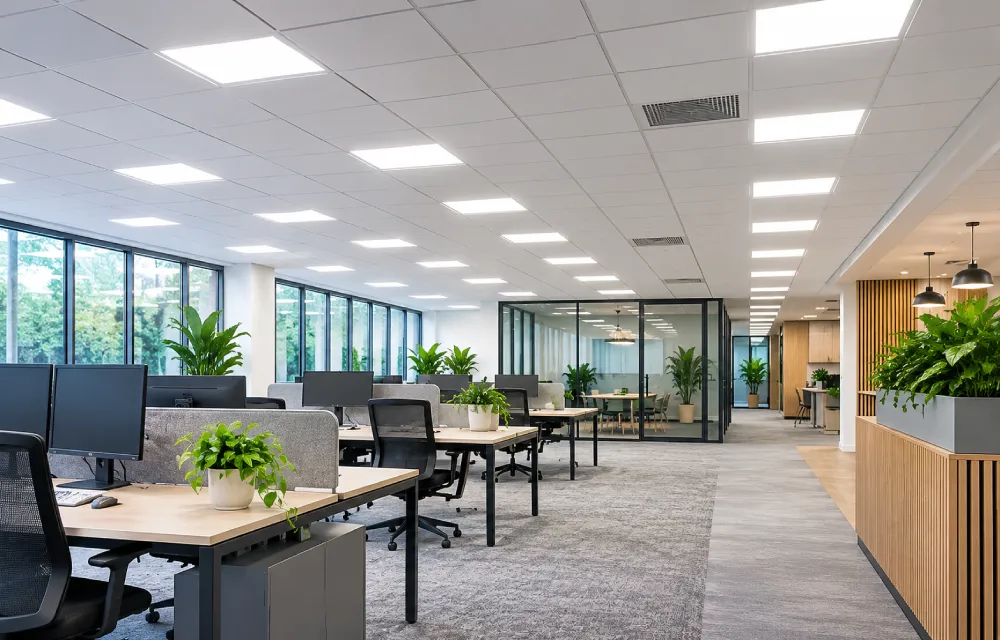
Consider desk positions, screen reflections, daylight and how meeting rooms are used. Panels, linear fittings or other luminaires should form part of a coordinated layout. Simply choosing a brighter fitting can create glare without improving the working environment.
Warehouses and Industrial Buildings
Mounting height, aisle width, shelving and the location of workstations influence fitting selection and positioning. The design should account for the environment, including dust, moisture or temperature where relevant, and allow safe access for future maintenance.
Retail and Hospitality Premises
Customer areas may need a combination of general, display and accent lighting. Consider how products, surfaces and colours appear, alongside practical needs at tills, kitchens and service areas. Confirm the proposed effect with samples or a trial area before ordering for the whole site.
Understand the Main Lighting Terms
Watts describe electrical power, while lumens describe light output. Lux describes the illumination reaching a surface. These measures answer different questions: choosing a lamp by wattage alone does not establish whether the task area will receive suitable light.
Colour temperature, measured in kelvin, describes whether light appears warmer or cooler. Colour rendering describes how colours appear under that light. Ask the designer to explain the proposed specification, including glare and dimming performance, in relation to your building rather than selecting one colour temperature for every area.
LED Retrofit or Complete Fitting Replacement?
Retrofitting means upgrading part of an existing lighting system. It can be appropriate where the fitting is suitable and compatible with the proposed lamp or components. Compatibility must be assessed: an LED tube is not automatically a direct substitute for every fluorescent tube.
Complete fitting replacement may be preferable where existing equipment is deteriorated, gives poor light distribution or cannot accommodate the required controls. Ask the contractor to explain any wiring modifications, product limitations and effect on maintenance. Electrical alterations should be carried out by a competent installer.
Plan Controls Alongside the Fittings
Occupancy sensors can reduce lighting operation in intermittently used areas. Daylight-linked controls can adjust artificial lighting where natural light is available, while schedules can align operation with building use. The value depends on actual occupancy and daylight rather than the presence of a sensor alone.
Agree zones, sensor locations, time delays and manual overrides before installation. Controls that switch off during quiet desk work or leave staff uncertain about operation can undermine the project. Include commissioning and user instruction in the quotation.
What Affects LED Lighting Installation Costs?
Costs depend on fitting quantities, product specification, access requirements, wiring condition and the controls included. Work at height, restricted access and installation outside normal opening hours can affect labour and equipment costs. Emergency lighting changes may add a separate scope.
Compare quotations using the same schedule of work. Check whether design, removal of existing equipment, responsible disposal, access equipment, testing, commissioning, documentation and VAT are included. For wider budgeting considerations, read how much electrical installation costs in the UK. Obtain a site-specific quote for the lighting project itself.
Estimate Energy Savings and Payback
Start with the total connected lighting load, including relevant control gear, and annual operating hours. Annual electricity use in kWh equals total power in kW multiplied by operating hours. Compare the existing and proposed systems, allowing for any changes in hours caused by controls.
For an illustration, reducing a 6 kW lighting load to 3 kW over 2,500 operating hours saves 7,500 kWh annually. At an assumed electricity rate of £0.25 per kWh, that equals £1,875 a year. These figures are an example, not an estimate for an IELEC project.
Simple payback is installed project cost divided by expected annual savings. Include evidenced maintenance savings where appropriate, and compare costs and savings on a consistent VAT basis. Future tariffs, operating patterns and replacement costs can change the result; confirm assumptions before approving investment.
What Happens During Installation?
The contractor agrees the scope and programme, plans safe access and coordinates electrical shutdowns with the building manager. Work may be phased by floor or room to maintain usable areas. Discuss business-critical equipment, tenant access and any out-of-hours requirements beforehand.
After installation, the work needs appropriate inspection and testing, followed by commissioning of controls and checks against the agreed design. Request relevant documentation, product and warranty information, and instructions for staff. Agree who to contact if a fitting fails or controls need adjustment.
Include Emergency Lighting in the Review
General LED lighting and emergency lighting have different functions. An ordinary fitting does not become emergency lighting because it uses LEDs. Changes to ceilings, partitions or escape routes should prompt a review of emergency lighting provision against the building’s fire safety arrangements.
GOV.UK guidance includes checking that emergency lighting works and recording faults. Confirm the testing and maintenance arrangements at handover. Where wider electrical checks are needed, our electrical testing and inspection service provides a relevant starting point for discussion.
Plan Your Commercial Lighting Project With IELEC
IELEC provides lighting and electrical installation services across London and Kent. Whether you are upgrading existing premises or coordinating lighting within a development, share your floor plans, operating hours and project requirements with our team. For development planning, see our new build electrical installation guide.
To discuss LED lighting installation for your commercial building, contact IELEC or call 01732 450541. We can discuss the scope and the information needed to prepare a suitable proposal.
Frequently Asked Questions
Sometimes, but the existing fitting, lamp holder, control gear and proposed LED product must be compatible. Some projects require wiring alterations or complete replacement. Ask an installer to assess the equipment rather than assuming that a matching lamp size makes a retrofit suitable.
Savings depend on the old and new lighting loads, operating hours and use of controls. Compare measured or reliably calculated consumption for equivalent lighting needs. A generic percentage cannot establish your building’s saving, particularly if efficient LED fittings are already installed.
Some projects can be phased around operating hours or completed in separate areas, but electrical isolation and safe access may require temporary closures. Discuss staff movements, customers, work at height and critical equipment with the contractor before agreeing the installation programme.
Yes. Fittings can need cleaning, controls may require adjustment and drivers or other components can fail. Emergency lighting has its own testing needs. Agree maintenance access, available replacement parts and warranty procedures, rather than treating an LED installation as a maintenance-free system.
Not always. The LED fitting or driver must suit the dimming system, and existing controls may need replacement. Specify the required dimming range and check compatibility before purchase. A sample installation can help identify unsuitable performance before the equipment is fitted throughout the building.
Look for relevant commercial project experience, appropriate electrical competence and a clear scope covering design, installation, testing and handover. Ask how the proposal addresses your working environment, disruption and maintenance. Compare the full specification and warranty arrangements rather than choosing on fitting price alone.