Commercial EICRs: The Complete Guide to Electrical Installation Condition Reports

Commercial electrical installations work hard every day. From offices and retail units to warehouses, schools and industrial premises, electrical systems can deteriorate through age, damage, environmental conditions, alterations and everyday use.
A Commercial Electrical Installation Condition Report (EICR) provides a detailed assessment of the condition and safety of a property’s fixed electrical installation. It can help businesses, landlords and facilities managers identify defects, manage electrical risks and maintain appropriate standards of electrical safety.
In this guide, iElec Electrical Contractors explains commercial EICRs, what inspectors check, how observations are classified and what happens when remedial electrical work is required.
What Is a Commercial EICR?
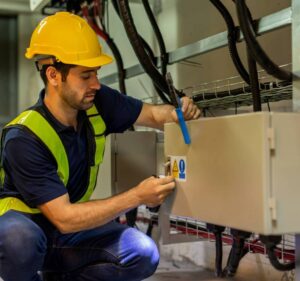
An Electrical Installation Condition Report (EICR) is produced following an inspection and testing process designed to assess the condition of an existing fixed electrical installation.
Unlike routine maintenance, an EICR considers whether there are defects, deterioration, damage or other conditions that could affect the continued safe use of the installation.
Commercial premises can contain considerably more complex electrical infrastructure than a typical home, including three-phase supplies, distribution boards, fixed equipment, extensive lighting systems and multiple circuits serving different parts of a building.
Following the inspection and testing, the findings are recorded in the EICR along with relevant observations and classification codes.
For businesses, an EICR can form an important part of an overall electrical safety and preventative maintenance strategy.
Who Needs a Commercial EICR?
A commercial EICR may be appropriate for organisations responsible for the safety and maintenance of electrical installations within premises such as:
- Offices
- Shops and retail premises
- Restaurants and hospitality venues
- Warehouses
- Factories and industrial facilities
- Schools and educational premises
- Commercial rental properties
- Public buildings
- Workshops
- Multi-occupancy commercial buildings
Employers and those responsible for commercial premises have duties relating to electrical safety under legislation including the Electricity at Work Regulations 1989.
The appropriate inspection and testing arrangements will depend on factors including the type of installation, its use, condition, environment and previous inspection findings.
How Often Should a Commercial EICR Be Carried Out?
There isn’t one inspection interval that should automatically be applied to every commercial electrical installation.
The appropriate interval depends on the type of premises, how the electrical installation is used, environmental conditions and the results of previous inspections.
The existing EICR should state the recommended date for the next periodic inspection. Higher-risk environments or installations subject to heavy use, moisture, dust, heat, vibration or potential physical damage may require more frequent attention.
Businesses should therefore follow the recommended inspection interval for their particular installation rather than assuming that every commercial building follows an identical schedule.
iElec can assess commercial electrical installations and advise clients on appropriate inspection, testing and maintenance requirements.
What Does an Electrician Inspect During a Commercial EICR?
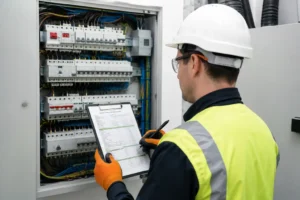
An EICR involves inspection and appropriate testing of the fixed electrical installation.
Depending on the premises and installation, this can include assessing:
- Distribution boards and protective devices
- Electrical circuits
- Earthing and bonding arrangements
- Wiring systems
- Accessories and connections
- Signs of deterioration or damage
- Protection against electric shock
- Protection against thermal effects
- Circuit identification and labelling
- Previous alterations to the installation
- Suitability of protective arrangements
Testing is also undertaken where appropriate to establish whether circuits and protective measures perform as required.
Commercial installations can be extensive, so careful planning may be required to minimise disruption while allowing suitable access for inspection and testing.
Understanding EICR Codes: C1, C2, C3 and FI
One of the most important sections of an EICR is the list of observations. Where an inspector identifies an issue, it may be assigned a classification code indicating its significance.
C1 – Danger Present
A C1 observation means danger is present and there is a risk of injury. Immediate action is required to remove the danger.
C2 – Potentially Dangerous
A C2 observation identifies a potentially dangerous condition. Urgent remedial action is required.
C3 – Improvement Recommended
A C3 observation means improvement is recommended. A C3 observation on its own does not make an EICR unsatisfactory, but it highlights an area where improving the installation would enhance electrical safety.
FI – Further Investigation Required
FI means further investigation is required without delay because the inspector cannot fully determine the nature or extent of a potential safety issue during the initial inspection.
Understanding these codes allows the person responsible for the premises to prioritise necessary electrical work appropriately.
What Happens After an Unsatisfactory EICR?
An EICR will generally be assessed as unsatisfactory where observations include C1, C2 or FI classifications.
An unsatisfactory report should not simply be filed away. The observations need to be reviewed and the appropriate action arranged.
The next steps may include:
- Reviewing the observations and classification codes.
- Prioritising dangerous or potentially dangerous defects.
- Arranging further investigation where an FI has been recorded.
- Completing the necessary remedial electrical work.
- Carrying out appropriate testing after repairs or alterations.
- Keeping documentation demonstrating the work completed.
The precise action required depends on the defects identified.
iElec provides commercial electrical testing alongside fault finding and remedial electrical works, helping businesses address problems identified during an EICR.
Commercial EICR vs PAT Testing: What’s the Difference?
EICRs and PAT testing are sometimes confused, but they assess different aspects of electrical safety.
An EICR primarily assesses the fixed electrical installation within a building. This includes fixed wiring, circuits, distribution equipment and associated electrical safety measures.
PAT testing, meanwhile, concerns electrical equipment and appliances.
For example, an office’s fixed wiring and distribution boards may fall within the scope of an EICR, while suitable electrical equipment used within the workplace may be managed through an appropriate equipment inspection and maintenance regime, which can include PAT testing.
Businesses may therefore use both as components of a broader electrical safety programme.
How to Prepare for a Commercial EICR
Good preparation can help an electrical inspection proceed efficiently and minimise unnecessary disruption.
Before the inspection, businesses and property managers should consider:
- Providing access to relevant electrical equipment and areas
- Locating previous EICRs and electrical certificates
- Identifying distribution boards
- Informing the electrician about known electrical problems
- Discussing operational restrictions
- Planning access to secure or restricted areas
- Informing relevant employees or occupants
- Discussing whether testing could affect business-critical equipment
Some electrical testing can require circuits or equipment to be isolated. For commercial environments, this means scheduling can be particularly important.
Businesses should discuss operational requirements with the electrical contractor before work begins so an appropriate inspection plan can be established.
Remedial Electrical Works Following an EICR
Where an EICR identifies electrical safety issues, remedial work may be necessary.
The work required will depend entirely on the observations recorded. Examples could include repairing damaged wiring, addressing defective connections, improving protective arrangements or replacing unsuitable electrical components.
Businesses should use appropriately competent electrical contractors to investigate and rectify identified defects.
After remedial work is completed, appropriate documentation should be retained alongside the original EICR to provide a clear record of the action taken.
Maintaining Electrical Compliance Between EICRs
An EICR provides an assessment at a particular point in time. Electrical safety management should therefore continue between periodic inspections.
Commercial organisations can support electrical safety through:
- Planned preventative electrical maintenance
- Prompt investigation of reported electrical problems
- Maintaining suitable electrical documentation
- Appropriate maintenance of electrical equipment
- Thermal imaging where appropriate
- Periodic inspection and testing
- Professional assessment following significant electrical alterations
- Using competent contractors for electrical work
This approach can help identify developing problems earlier and reduce the likelihood of electrical faults causing disruption.
Why Choose iElec for Commercial EICRs?
iElec Electrical Contractors provides professional electrical services for commercial and industrial clients across London, Kent and surrounding areas.
With more than 20 years of electrical industry experience, our team supports businesses with electrical inspection and testing, installation, maintenance and remedial works.
Working with iElec provides access to:
- NICEIC Approved Electrical Contractors
- Experienced electrical engineers
- Commercial and industrial electrical expertise
- EICR inspection and testing
- Remedial electrical works
- Planned electrical maintenance
- Thermal imaging services
- Electrical testing and PAT testing
- Compliance-focused workmanship
- Support across London and Kent
Our focus is on helping clients maintain safe, reliable electrical installations while minimising unnecessary disruption to their operations.
Book a Commercial EICR in London or Kent
If your commercial property’s electrical installation is due for inspection, iElec can provide professional commercial EICR inspection and testing across London, Kent and surrounding areas.
Whether you manage an office, retail unit, warehouse, development or industrial facility, our experienced team can assess your electrical installation and clearly explain any findings or remedial work required.
Contact iElec Electrical Contractors today to discuss your commercial EICR requirements or arrange an inspection.
Frequently Asked Questions
No. An EICR assesses the fixed electrical installation, including wiring, circuits and distribution equipment. PAT testing relates to electrical appliances and equipment. Businesses may require appropriate measures for both areas as part of their wider electrical safety, inspection and maintenance arrangements within a commercial property or workplace.